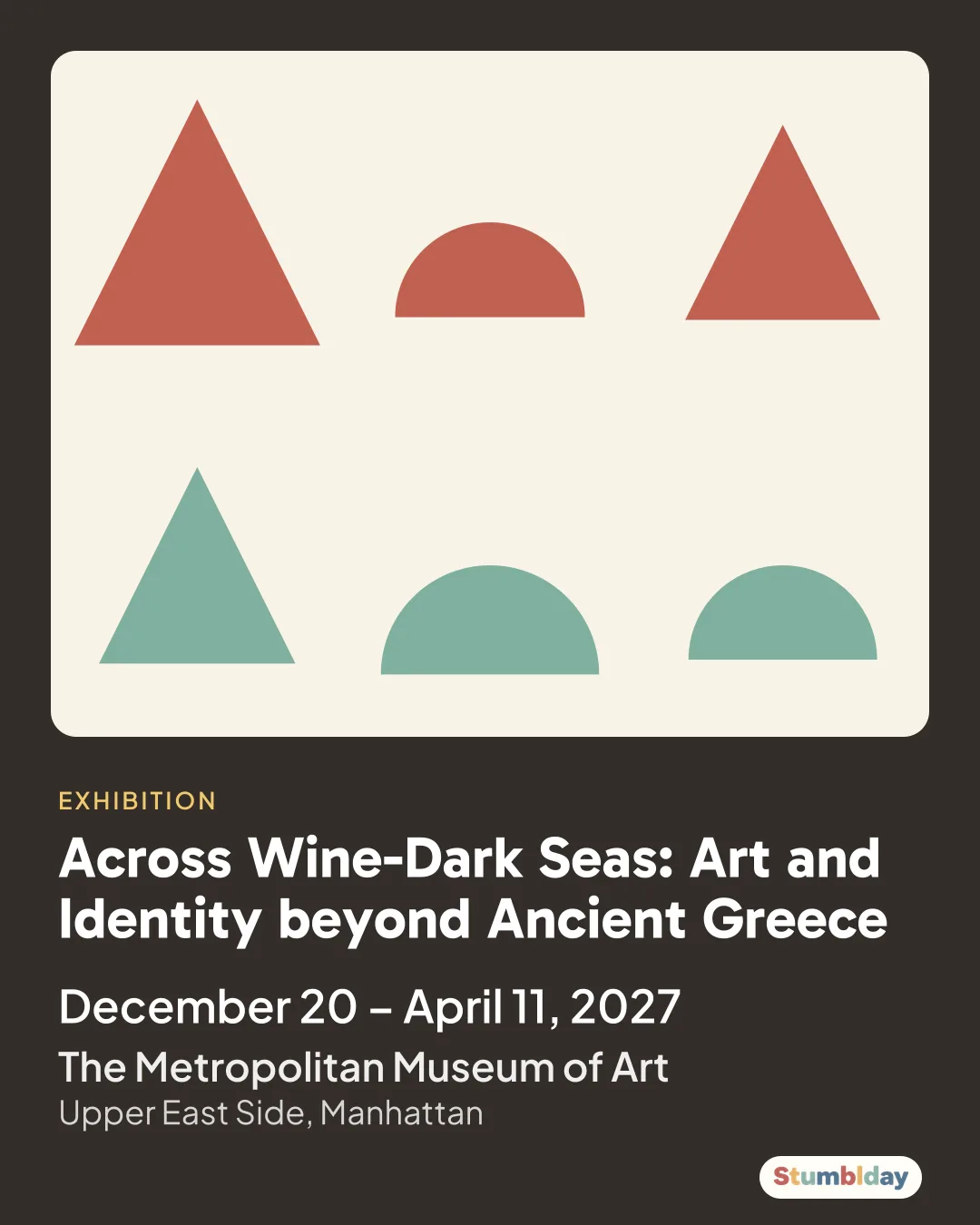
About
More than 180 works in stone, metal, terracotta, glass and amber trace how Greek art was reshaped by everyone the Greeks met.
This is the period that produced the city-state, the Olympic Games, the Greek alphabet borrowed from the Phoenicians and the Homeric epics, and the show argues all of it came from contact rather than isolation. More than 180 works in stone, metal, terracotta, glass and amber are grouped by region so you watch influence travel. One cup shows Herakles sailing west in the sun god's cauldron.
What to expect
The galleries are arranged geographically rather than chronologically, moving from the Eastern Mediterranean and West Asia through Egypt and North Africa, Italy and Sicily, the Western Mediterranean and the Black Sea. Objects are small and dense, so this is a lean-in show. Expect a fresh crowd, since it opens in the last stretch of the year.
Good to know
- Take the 4/5/6 to 86th Street; the 81st Street entrance is the shorter queue.
- It sits near the Greek and Roman galleries, so pair it with the Cypriot and Hellenistic rooms.
- Objects are small and detailed — a newly opened show means peak crowding at the cases.
- New York State residents and NY/NJ/CT students can pay what they wish.
- Step-free throughout, with seating in the larger galleries.
Going? Keep it.





Common questions
How many objects are on view?
More than 180 exceptional works, in stone, metal, terracotta, glass and amber.
What period does it cover?
The eighth through early fifth centuries BCE, when maritime trade routes carried Greek artists far from home.
How is it organized?
Geographically — Eastern Mediterranean and West Asia, Egypt and North Africa, Italy and Sicily and Sardinia, the Western Mediterranean and Europe, and the Balkans and Black Sea.